Hylandia dockrillii vs Fontainea picrosperma: The Blushwood Misidentification That Has Misled the Internet for a Decade
Two plants share the name Blushwood, but only one contains EBC-46. A decade of media misidentification has wrongly attributed tigilanol tiglate to Hylandia dockrillii — here is the full story.

The Short Answer: They Are Two Completely Different Plants
Hylandia dockrillii and Fontainea picrosperma are not the same plant. They are not synonyms. They are not two names for the same species. They are distinct species in separate genera — both in the family Euphorbiaceae, both native to the rainforests of north Queensland, and both sharing the common name "Blushwood." That shared common name is the sole origin of one of the most persistent and consequential misidentifications in the natural supplement space. [1]
Every published scientific study on EBC-46 — the compound also known as tigilanol tiglate — identifies its source as Fontainea picrosperma. [2] There is no peer-reviewed evidence that tigilanol tiglate exists in Hylandia dockrillii. No study has isolated, characterised, or quantified EBC-46 from Hylandia dockrillii. Products claiming to contain EBC-46 derived from Hylandia dockrillii are either mislabelled or built on the misidentification that swept through online media beginning around 2014.
The Botany: Two Genera, One Shared Common Name
Fontainea picrosperma
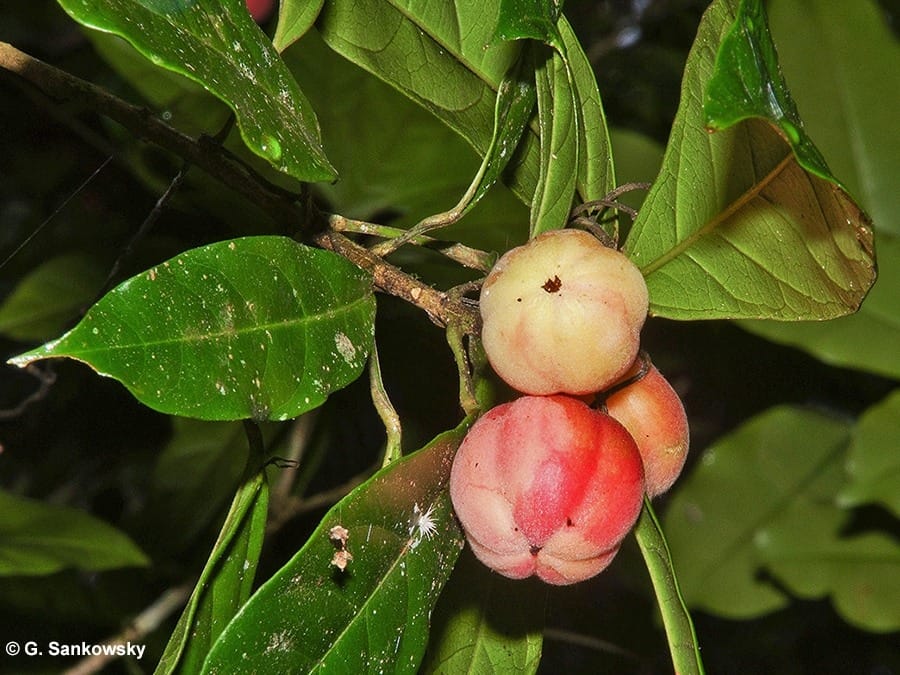
Fontainea picrosperma is a species within the genus Fontainea, a small genus of around six species restricted to eastern Australia and Vanuatu. [3] It is a small to medium-sized rainforest tree growing at altitude in the Wet Tropics of north Queensland, with a fleshy purple-pigmented berry — the Blushwood berry — whose seed is the source of tigilanol tiglate. Researchers at QIMR Berghofer identified the compound from this species in the 1990s, and all subsequent pharmacological development — including QBiotics' clinical programme and the FDA-approved veterinary drug Stelfonta — has been based on extracts from Fontainea picrosperma. [4]
Hylandia dockrillii
Hylandia dockrillii is the sole species in the genus Hylandia — a monotypic genus also in the Euphorbiaceae family, also native to north Queensland's Wet Tropics. [5] It is also commonly called "Blushwood." It is a different tree, a different genus, and a different chemistry. Despite sharing a habitat and a common name with Fontainea picrosperma, Hylandia dockrillii has not been the subject of EBC-46 research. No tigilanol tiglate or related epoxytigliane diterpene ester has been identified in Hylandia dockrillii in any published study.
To put this in perspective: sharing the common name "Blushwood" no more makes these two plants equivalent than sharing the name "ironwood" makes dozens of unrelated tree species around the world the same plant. Common names are geographically and culturally assigned. In botanical science, genus and species names are the only reliable identifiers — and Fontainea and Hylandia are unambiguously distinct.
How the Misidentification Spread: A Documented Timeline
The confusion has a traceable origin. In 2014, the landmark paper by Boyle et al. published in PLOS ONE described EBC-46's remarkable anti-tumour effects in preclinical models, identifying Fontainea picrosperma as the source plant. [1] The paper was picked up by science journalists and quickly amplified into mainstream media. The coverage was broadly accurate in its pharmacological claims — but many reporters, working without botanical expertise, reached for whichever name appeared first in their searches for "Blushwood tree Queensland."
Hylandia dockrillii, being a monotypic genus with a more searchable taxonomic profile in some regional databases, appeared prominently in those searches. Several high-traffic articles — some of which remain indexed and widely read today — reported the discovery as involving Hylandia dockrillii. That error propagated. It was copy-pasted across blogs, forums, supplement retailer product descriptions, and eventually into the marketing materials of companies selling products they claimed were EBC-46 derived from Hylandia dockrillii.
The scientific literature never made this error. Every PubMed-indexed study on tigilanol tiglate cites Fontainea picrosperma. [2] The gene biomarker identification study, the synthesis papers, the Phase I human trial, and the pivotal veterinary trial all reference Fontainea picrosperma unambiguously. [6][7][8] The misidentification exists entirely in the popular and commercial sphere — not in the research record.
Why This Matters for Consumers and Researchers
For consumers purchasing supplements
If a blushwood berry supplement labels its source species as Hylandia dockrillii, the buyer has no scientific basis to assume that product contains tigilanol tiglate. The active compound has been identified in, extracted from, and characterised exclusively in Fontainea picrosperma. [4] A product derived from Hylandia dockrillii may contain other Euphorbiaceae-derived compounds — some of which could themselves have biological activity — but it cannot be assumed to contain EBC-46.
This is not a minor labelling quibble. For someone investigating blushwood extract for a serious health concern, buying a mislabelled product means potentially consuming something with an entirely different and unstudied phytochemical profile. Species identity is the foundation of evidence-based natural medicine. It is the reason that pharmacognosy, the study of drugs derived from natural sources, has always insisted on rigorous botanical authentication before any therapeutic claim can be made.
For the integrity of the research narrative
The misidentification has also muddied the research narrative in ways that make it harder for the public to understand what is actually known about EBC-46. When consumers read articles attributing the compound to Hylandia dockrillii and then search for that species, they find nothing in the clinical literature — which can generate false scepticism about whether EBC-46 research is real. It is very real. It is simply all attributed to the correct plant: Fontainea picrosperma. [9]
How to Verify Which Species a Product Actually Contains
Any reputable blushwood berry supplement should be able to provide batch-level documentation confirming the botanical source of its extract. The key things to look for are:
- The Latin binomial on the label or certificate of analysis: it should read Fontainea picrosperma, not Hylandia dockrillii
- Reference to cultivation or sourcing from known Fontainea picrosperma growing operations — the species is native to north Queensland and cultivated in controlled environments in Australia and Asia
- Transparency about extraction method: seed extraction is the pharmacologically validated route, consistent with where tigilanol tiglate concentrates in the fruit
Botanical authentication is not an exotic standard to hold supplement companies to — it is the baseline of responsible natural product manufacturing. The fact that this clarification is still necessary in 2026 reflects how deeply the original misidentification embedded itself in the popular literature, and how much work remains to establish accurate public understanding of what EBC-46 is and where it comes from.
What the Published Science Actually Establishes
To be unambiguous about the state of the evidence:
- Tigilanol tiglate (EBC-46) has been isolated and characterised from Fontainea picrosperma [Boyle et al., 2014; Panizza et al., 2019]
- Gene biomarker studies have been conducted on Fontainea picrosperma to identify cultivars with higher tigilanol tiglate expression [PMC9268252]
- Total and partial synthesis routes have been developed using tigilanol tiglate as the reference compound isolated from Fontainea picrosperma [PMC10079359]
- The FDA-approved veterinary drug Stelfonta is manufactured from tigilanol tiglate sourced from Fontainea picrosperma
- Active human clinical trials reference Fontainea picrosperma-derived tigilanol tiglate [ClinicalTrials.gov]
- No peer-reviewed publication has identified EBC-46 or tigilanol tiglate in Hylandia dockrillii
This is not a contested area of science. The botanical source of EBC-46 is Fontainea picrosperma — a fact established across dozens of independent peer-reviewed publications and confirmed by two regulatory bodies. [9] The persistence of Hylandia dockrillii as an alternative attribution in the popular literature is a media artefact, not a scientific disagreement.
Frequently Asked Questions
Are Hylandia dockrillii and Fontainea picrosperma the same plant?
No. They are two distinct species in separate genera within the Euphorbiaceae family. Both are native to north Queensland and share the common name "Blushwood," which is the source of widespread confusion. Botanically and chemically, they are different plants.
Does Hylandia dockrillii contain EBC-46?
There is no published scientific evidence that Hylandia dockrillii contains tigilanol tiglate (EBC-46) or any related epoxytigliane diterpene ester. Every study that has isolated, characterised, or clinically evaluated EBC-46 identifies Fontainea picrosperma as the source plant.
Why do so many websites say EBC-46 comes from Hylandia dockrillii?
The misidentification originated in media coverage following the 2014 publication of foundational EBC-46 research. Journalists reporting on the "Blushwood tree" incorrectly identified the species as Hylandia dockrillii in several widely-read articles. That error was then copy-pasted across blogs, supplement websites, and product listings, where it remains embedded today. The scientific literature has never contained this error — every peer-reviewed paper attributes EBC-46 to Fontainea picrosperma.
Which species should a Blushwood berry supplement be derived from?
Fontainea picrosperma. This is the only species from which tigilanol tiglate has been scientifically identified and validated. A product claiming to contain EBC-46 but labelling its source as Hylandia dockrillii cannot be verified against the published research.
Is Fontainea picrosperma the same as the Blushwood tree?
Yes — Fontainea picrosperma is the correct botanical name for the Blushwood tree whose fruit contains EBC-46. The common name "Blushwood" is also sometimes applied to Hylandia dockrillii, which is a separate species. In any scientific or supplement context, Fontainea picrosperma is the name that matters.
Where does Fontainea picrosperma grow?
Fontainea picrosperma grows wild only in the Wet Tropics of north Queensland, Australia. It has also been successfully cultivated in controlled indoor environments in Australia and Asia, making cultivation-based commercial supply feasible beyond its native wild range.
References
- 1. Boyle GM et al. Intratumoural injection of EBC-46 in combination with systemic chemotherapy induces rapid tumour destruction. PLoS ONE. 2014. View source ↗
- 2. Phuwapraisirisan P et al. Identification of Gene Biomarkers for Tigilanol Tiglate Content in Fontainea picrosperma. Front Plant Sci. 2022. View source ↗
- 3. iNaturalist. Fontainea picrosperma — Blushwood tree taxonomy. View source ↗
- 4. QBiotics Group. Tigilanol Tiglate Development Programme. View source ↗
- 5. GBIF. Hylandia dockrillii Airy Shaw — species profile. View source ↗
- 6. Williams CM et al. Practical synthesis of tigilanol tiglate and analogues. RSC Chem Biol. 2023. View source ↗
- 7. Panizza BJ et al. Phase I dose-escalation study of EBC-46 in patients with solid tumours. EBioMedicine. 2019. View source ↗
- 8. de Ridder TR et al. Randomized controlled trial of tigilanol tiglate for canine mast cell tumors. J Vet Intern Med. 2021. View source ↗
- 9. FDA. FDA Approves First Drug for Direct Treatment of Non-Metastatic Canine Mast Cell Tumors. 2020. View source ↗
- 10. ClinicalTrials.gov. Tigilanol Tiglate Studies. View source ↗
- 11. QIMR Berghofer Medical Research Institute. EBC-46 Research. View source ↗